
Metal Roof Restoration: Can Coatings Really Add 15 Years to Your Roof?


A metal roof that has started rusting at the fasteners, chalking under the Texas sun, and leaking during heavy rain does not automatically need to come off. That assumption costs Central Texas property owners a great deal of money every year. In many cases, the metal panels underneath are still structurally capable of decades more service. What has failed is the protective layer on top of them, along with the seams and penetrations that were never designed to stay watertight forever.
Restoration addresses exactly that. Done properly on a roof that qualifies, a coating system can push the useful life of an aging metal roof out another 15 years or more. Here is how that works, what determines whether your roof is a candidate, and how to tell the difference between a restoration that lasts and one that peels in three summers.
What Metal Roof Restoration Actually Involves
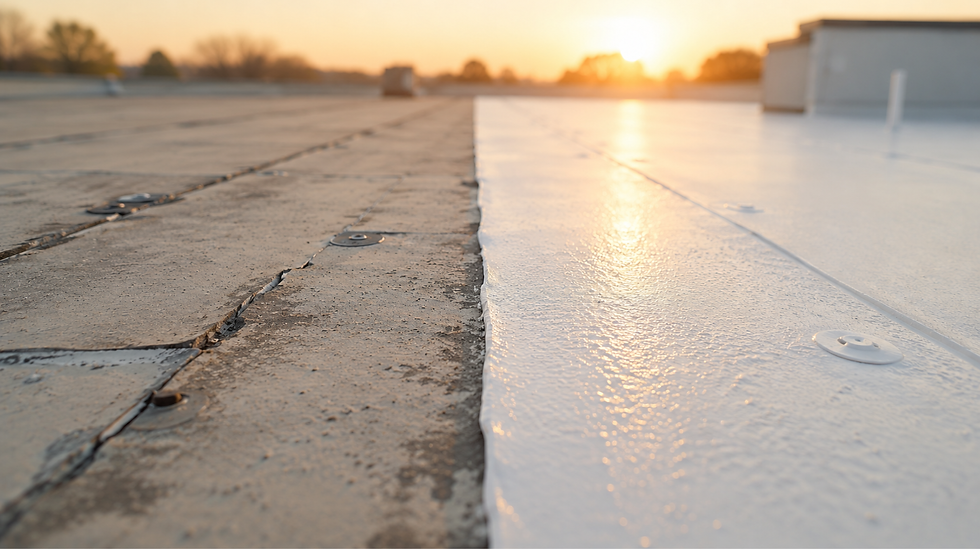
Restoration is the process of cleaning, repairing, and recoating a roof you already own so it performs like a sealed system again. Nothing gets torn off. The existing panels stay in place and become the substrate for a fluid-applied membrane that cures into a single continuous surface across the entire roof, including the seams and fasteners that cause most metal roof leaks.
That distinction matters more than it might sound. A metal roof leaks at its joints far more often than through the panels themselves. Seams open up, fasteners back out, and sealant around curbs and skylights dries and cracks. A coating system bridges all of those weak points at once instead of chasing them individually with patch repairs year after year.
These systems are also a different product category than paint. Industry technical resources describe them as thick, high-solids membranes formulated with elastic resins that stay flexible through years of expansion and contraction and are applied at several gallons per hundred square feet rather than a fraction of a gallon. That elasticity is what lets a coating move with a metal roof instead of cracking along with it.
Why Metal Roofs Age Faster in Central Texas
San Antonio puts a specific kind of stress on metal roofing, and understanding it explains why restoration timelines here look different than they do in milder climates.
Thermal movement. Metal expands and contracts more than almost any other roofing material. On a summer day when a dark or weathered panel surface climbs well above ambient temperature, then cools sharply after an evening storm, the panels move. Repeat that daily for fifteen years and fasteners loosen, seams work open, and stress cracks form near attachment points.
UV breakdown. Factory finishes are durable, but they are not permanent. Constant high-intensity sun degrades the finish until the surface chalks, fades, and loses its ability to shed water cleanly.
Corrosion at the details. Humidity, morning condensation, and standing water at low-slope transitions accelerate rust. It usually starts small, at a scratch, a cut edge, or around a fastener head, and spreads outward from there.
Sealant fatigue. The caulking around penetrations has the shortest service life of anything on the roof. It is almost always the first thing to fail and the most common source of the leak that finally gets a property owner's attention.
So Can a Coating Add 15 Years? The Honest Answer
Yes, and that number is realistic rather than optimistic, but only when several things line up.
The condition of the roof at the time of restoration matters most. A metal roof with surface corrosion, some loose fasteners, and a few isolated leaks is an excellent candidate. A roof with widespread perforation, saturated insulation beneath the deck, or structural damage is not, and no coating will fix those problems.
Preparation drives everything after that. Coatings fail because of adhesion, and adhesion fails because of contamination. A roof that was not properly cleaned, or where rust was coated over instead of treated, will lose the membrane long before the material's rated life.
Film thickness is the third variable, and it is invisible once the job is done. Applying less material than the system specifies is the easiest way for a contractor to cut cost, and it quietly cuts service life along with it. Reputable applicators measure wet mil thickness during application rather than estimating.
Finally, maintenance determines whether you get the full term. A coated roof that gets inspected annually and touched up as needed will comfortably reach the top of its expected range, and can then be recoated at a fraction of the original cost to start the clock again.
Choosing the Right Coating System for a Metal Roof
Three system types account for most quality metal roof restorations, and each has a clear best use.
Silicone roof coatings handle moisture better than anything else available. They resist ponding water, hold up under sustained UV exposure without becoming brittle, and are a strong choice for low-slope metal roofs or areas where water tends to sit near drains and transitions.
Acrylic roof coatings offer excellent reflectivity at a lower cost and perform well on sloped metal roofs that drain quickly. They are water-based, easy to recoat, and a practical fit for buildings where energy savings are a primary goal and drainage is not a problem.
Elastomeric roof coatings are built around flexibility, stretching and recovering as panels move through daily temperature swings. On a roof with significant thermal cycling, that movement tolerance is the difference between a membrane that stays intact and one that splits at the seams.
The reflectivity these systems provide is a meaningful secondary benefit in this climate. A bright, reflective surface lowers rooftop temperature substantially, which reduces cooling demand inside the building and eases the thermal cycling that damaged the roof in the first place.
What a Quality Restoration Looks Like Step by Step

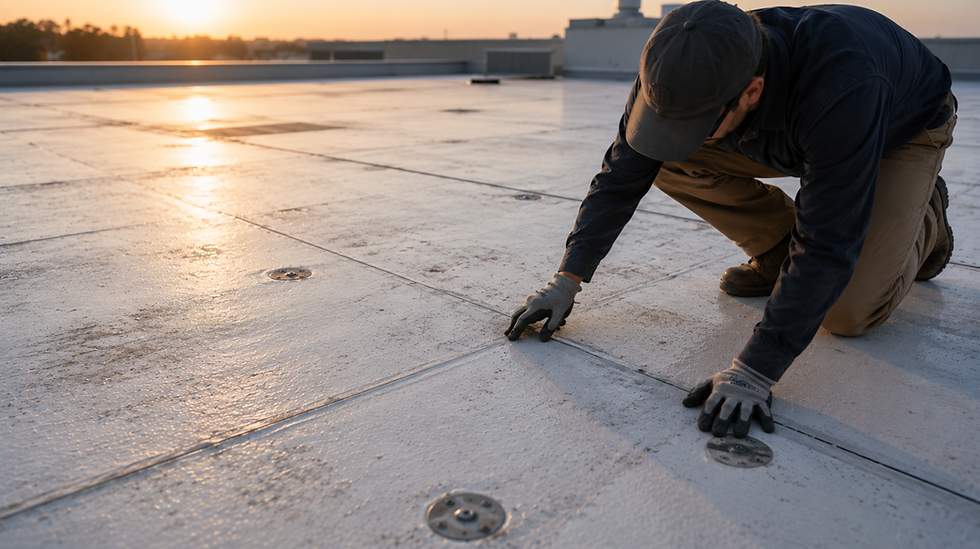
Assessment. A thorough inspection documents corrosion, fastener condition, seam separation, moisture in the assembly, and whether the roof qualifies for restoration at all. This is where an honest contractor tells you if coating is the wrong answer.
Repairs. Loose or backed-out fasteners are replaced, rusted areas are treated and primed, and damaged panel sections are addressed before anything else happens.
Cleaning. The entire surface is pressure washed to remove chalk, dirt, oxidation, and any failing finish. The roof must be fully dry before coating begins.
Detail work. Seams, fastener rows, curbs, and penetrations are reinforced with fabric embedded in the coating, creating extra thickness exactly where movement and water intrusion concentrate.
Base and top coats. The system is applied at specified thickness in the correct sequence, with thickness verified as work proceeds.
Final inspection. Coverage, adhesion, and detail work are checked before the warranty is issued.
Most projects take one to three weeks depending on size and complexity, and because there is no tear-off, the building typically stays fully operational throughout.
The Financial Case Against Premature Replacement
Restoration generally runs a fraction of replacement cost for a comparable roof area. The savings come from more than materials. There is no demolition labor, no disposal fees, no landfill tipping charges, and no business interruption while the building sits exposed.
There is also a tax consideration worth raising with your accountant. Because coating work is classified as maintenance and restoration rather than a new roof installation, the expense can often be treated differently than a capital improvement that must be depreciated across many years. That treatment depends on your specific situation, so confirm it with your CPA rather than assuming.
Knowing When to Act
The best window for restoration comes well before the roof reaches crisis condition. Watch for surface rust starting to appear, chalky residue that comes off on your hand, occasional leaks during driving rain, visible gaps at seams, and cooling costs that keep climbing without an obvious cause. A roof showing these signs is usually still a strong candidate.
Waiting until the deck is saturated and panels are perforated eliminates restoration as an option entirely, which is the outcome nobody wants. Click here to learn more about commercial roof care that extends service life and helps you catch these conditions early.
At RoofHelp! | Coatings, our work centers on inspections, assessments, and coating and restoration systems designed to get more life out of the roof already on the building, across San Antonio and surrounding communities including New Braunfels, Boerne, Austin, and San Marcos.
Frequently Asked Questions
How long does a metal roof coating actually last?
Depending on the system, application quality, and maintenance, most metal roof coating systems perform for 10 to 20 years. Recoating at the end of that term extends protection further without starting over.
Will a coating stop existing leaks?
In most cases, yes. Coating systems seal seams, fasteners, and penetrations, which is where the large majority of metal roof leaks originate. Leaks caused by structural failure or saturated insulation need to be corrected before coating.
Can any metal roof be restored?
No. Roofs with widespread perforation, significant structural damage, or trapped moisture in the assembly are not candidates. A professional assessment is the only reliable way to determine eligibility.
Does the building have to shut down during the work?
Almost never. Since there is no tear-off, restoration causes minimal disruption and most facilities continue operating normally throughout the project.
Will restoration lower my energy bills?
Reflective coating systems reduce rooftop surface temperature significantly, which lowers cooling demand during Texas summers. The size of the savings depends on the building, insulation, and existing roof color.
Conclusion
A 15-year extension on an aging metal roof is not a marketing claim. It is a realistic outcome when a qualified roof is properly prepared, coated at the correct thickness with the right system, and maintained afterward. The critical part of the process happens before any coating is applied, in an honest evaluation of whether restoration is genuinely the right answer for your building.
If your metal roof is showing rust, chalking, or occasional leaks, have it assessed while restoration is still on the table. Schedule a professional roof assessment to find out what your roof qualifies for and what kind of service life you can realistically expect from it.

Comments