
Is Your Commercial Roof Ready for Solar Panels?


A rooftop solar array is a twenty five year commitment bolted to a surface that may only have eight years left in it. That mismatch is the most expensive mistake building owners make when they go solar, and it almost never appears in the proposal.
Solar contractors are good at what they do. They evaluate sun exposure, shading, electrical service, and load. What they rarely evaluate in depth is whether the roof underneath the racking will still be watertight in year twelve. If it is not, someone has to pay to detach the array, address the roof, and reset everything. That cost lands squarely on the building owner, and it arrives on the roof's schedule rather than yours.
The encouraging part is that most commercial roofs across Central Texas can be brought up to solar readiness without tearing anything off. It just has to happen in the right order.
What "Solar Ready" Actually Means
The phrase gets used loosely, so it helps to define it in practical terms. A roof is genuinely ready for a solar installation when four things are true.
It is watertight today and has a documented path to staying watertight for the full service life of the array. It can carry the additional dead load of panels and racking, which a licensed structural engineer should confirm rather than anyone estimating from the ground. It drains properly, since standing water becomes a much bigger problem once racking blocks the flow. And it remains accessible enough that a technician can still inspect seams and flashings after the panels are in place.
Miss any one of those and the array will eventually sit on a liability instead of an asset.
Assess the Roof Before You Sign the Solar Contract
An honest condition assessment is inexpensive compared to what it prevents. Here is what actually matters during that evaluation.
Remaining Service Life
Age alone is a poor indicator. A fifteen year old modified bitumen roof that was maintained can be in better shape than a nine year old single ply that was neglected. What matters is remaining service life, measured against the twenty five year horizon of a solar investment. If the gap is more than a few years, that gap needs to be closed before installation, not after.
Trapped Moisture in the Assembly
This is the finding that changes plans most often. Water sitting inside insulation will not be solved by anything applied on top of it, and covering wet insulation with panels makes the problem invisible until it becomes a structural one. Moisture survey work identifies saturated areas so they can be cut out and replaced before any restoration work begins.
Seams, Flashings, and Existing Penetrations
Most commercial roof leaks start at transitions rather than in the open field. Curbs, drains, pitch pockets, parapet terminations, and lap seams all deserve close attention. Every one of them is a spot that becomes hard to reach once racking is overhead.
Drainage and Ponding
Solar racking changes how water and debris move across a roof. Areas that drained slowly before will drain more slowly afterward. Ponding accelerates membrane breakdown, promotes biological growth, and adds weight the roof was not designed to carry indefinitely. Drainage issues should be corrected while the surface is still open.
Restoration Is Usually the Practical Path Forward
When an assessment turns up an aging but structurally sound roof, owners often assume the only options are replacement or crossing their fingers. There is a third option that fits the solar timeline much better.
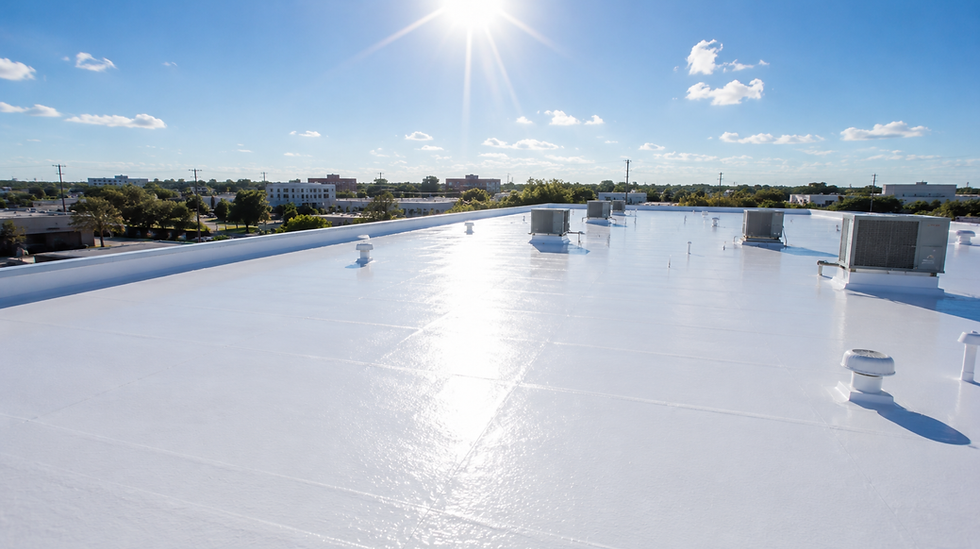
A fluid applied restoration system rebuilds the weatherproofing layer over the existing roof. Damaged areas are repaired, seams and penetrations are reinforced with fabric and detail work, and a monolithic membrane is applied across the entire surface. The result is a seamless barrier with no fasteners, no tear off, and no disposal of the old system. Silicone systems handle standing water and intense sun exposure well. Acrylic and elastomeric systems offer excellent reflectivity and flexibility across temperature swings. The right choice depends on the substrate, the slope, and how the roof behaves in ponding conditions.
There is a financial dimension worth raising with your accountant as well. Because coating systems are treated as restoration rather than a new roof installation, the expense is frequently handled differently on the books than a full replacement would be. That distinction can meaningfully change the math on a solar project budget.
Click here to learn more about flat roof restoration and how coating systems extend a roof's service life.
One caution: restoration is not a universal fix. Roofs with widespread saturated insulation, failing decking, or structural deficiencies need a different solution, and any honest assessment will say so plainly rather than selling a coating that cannot succeed.
A Reflective Surface Helps the Array, Not Just the Roof

Here is a benefit that rarely makes it into solar proposals. Photovoltaic modules lose efficiency as they heat up. Output drops by a fraction of a percent for every degree the cells rise above their rated operating temperature, and on a dark commercial roof in July, surface temperatures climb far higher than the ambient air.
A reflective coating lowers that surface temperature substantially. Cooler air moving beneath the panels means modules run closer to their rated output during exactly the hours when production and utility demand both peak. The same reflectivity reduces heat transfer into the building below, which eases the load on rooftop HVAC units that are often sharing the roof with the array.
You get a restored roof, better panel performance, and lower cooling costs from a single scope of work.
Sequence the Work So Nothing Gets Done Twice
Order of operations decides whether this project goes smoothly or expensively. Local rules shape the timeline too, since interconnection requirements and rebate terms vary by utility and are worth reviewing before the roof scope is locked in.
Complete the roof condition assessment and moisture survey first, before the solar design is finalized.
Share the findings with your solar provider so racking layout accounts for drainage paths and service access.
Have structural load capacity verified by a qualified engineer.
Complete repairs and restoration, allowing the coating system full cure time before anything is set on it.
Coordinate installation timing so racking crews are not walking on a green coating.
Establish an inspection schedule for the areas that will be harder to reach afterward.
Skipping step one is how owners end up paying twice.
What Central Texas Weather Adds to the Equation
Roofs in the San Antonio area take punishment that milder climates never see. Extreme summer surface temperatures drive daily thermal cycling that works seams loose over time. Spring hail events leave bruising that may not leak for years. Strong wind events test every termination and edge detail. Add a solar array with its own uplift characteristics and the margin for a marginal roof disappears.
Property managers in Austin, New Braunfels, Boerne, and San Marcos face the same conditions, and the same principle applies. The roof has to be the most reliable component of the system, because it is the one holding everything else up.
Frequently Asked Questions
Can a roof coating be applied after solar panels are already installed?
Partially, but not well. Crews cannot access the substrate beneath racking and panels, which leaves the most vulnerable areas untreated. Restoration performed before installation covers the full roof surface without compromise.
How do I know if my roof needs restoration or replacement before solar?
It comes down to the condition of what lies beneath the surface. Sound decking and dry insulation generally point toward restoration. Widespread saturation or deteriorated structural components point toward replacement, which a full assessment will identify clearly.
Will a coating system void my existing roof warranty?
It depends on the terms of your current warranty and the manufacturer involved. Review the documentation before work begins, and involve your roofing consultant in that conversation early.
How long does a restored commercial roof last?
A properly prepared and correctly specified system typically delivers ten to twenty years of service, and it can be recoated at the end of that period to extend performance further without tear off. That renewable cycle aligns well with the lifespan of a solar array.
Does a reflective coating really improve solar output?
It contributes. Cooler rooftop conditions help modules operate closer to their rated efficiency during peak heat, and the effect is most noticeable in climates with long, intense summers.
Who should perform the roof evaluation, my solar installer or a roofing professional?
A roofing professional. Solar installers assess mounting feasibility, not membrane condition, moisture content, or remaining service life. Those are separate disciplines, and the roof deserves its own expert opinion.
Conclusion
Solar is a strong investment for commercial property owners in Central Texas, and it works best when the roof beneath it is treated as part of the project rather than an afterthought. A thorough assessment, targeted repairs, and a restoration system applied before installation day protect both the building and the array for decades.
If you are weighing a solar project on an aging commercial roof, start with an honest look at what you are working with. The team at RoofHelp! | Coatings provides commercial roof assessments and restoration systems built for the conditions Texas buildings face. Schedule a roof evaluation and find out exactly where your roof stands before the panels go up.


Comments