
How a Reflective Roof Coating Changes What You Pay to Cool Your Building

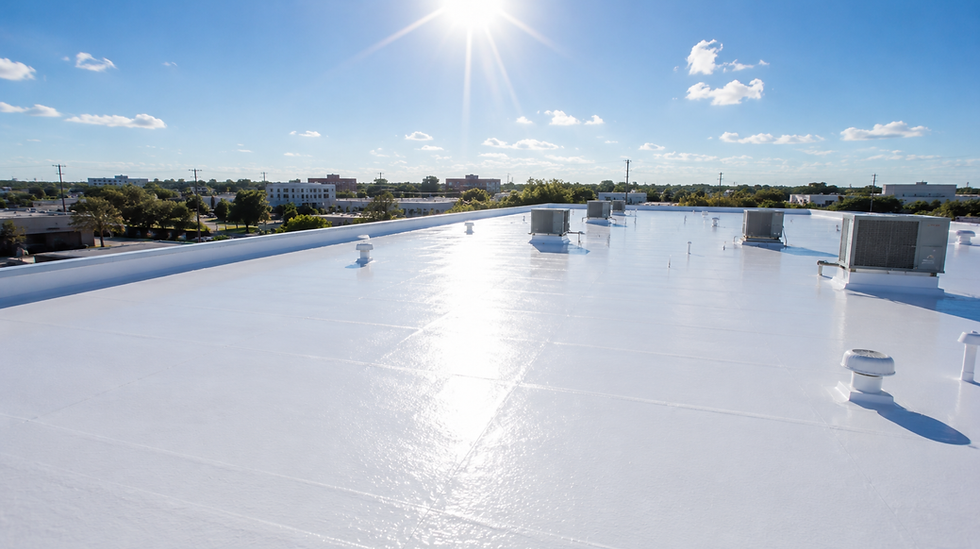
Stand on a dark low-slope roof in San Antonio at three in the afternoon in August and you can feel the problem through your boots. Air temperature might be 98 degrees. The roof surface underneath you is often somewhere between 150 and 190. That heat does not stop at the membrane. It works its way down through the deck and the insulation, into the space below, and your air conditioning spends the rest of the day fighting it.
Most property owners look at a high summer utility bill and think about the HVAC unit.
The roof rarely comes up. But the roof is the single largest surface your building presents to the sun, and how it handles that exposure sets the baseline for everything the cooling system has to do.
Why a Dark Roof Quietly Raises Your Operating Costs
A dark, weathered roof surface absorbs the overwhelming majority of the solar energy that hits it. That absorbed energy has to go somewhere. Some radiates back to the sky, some transfers into the building, and the rest cooks the roofing materials themselves.
The costs show up in three places:
Longer cooling runtimes. Your equipment cycles more often and runs longer, particularly during the late afternoon stretch when outdoor temperatures and roof temperatures both peak.
Higher peak demand. For commercial accounts billed on demand, the most expensive kilowatt of the month is usually pulled on a hot afternoon. A hot roof pushes you toward that peak instead of away from it.
Faster material breakdown. A surface that swings from 180 degrees at four in the afternoon to 75 degrees at dawn is expanding and contracting every single day. That daily movement is what opens seams, cracks flashing details, and pulls fasteners loose over time.
The third one matters more than most energy comparisons admit, and it is worth coming back to.
What "Reflective" Actually Means
Two measurable properties determine whether a roof surface stays cool. Understanding them makes it much easier to evaluate what a contractor is proposing.
Solar Reflectance
This is the share of solar energy the surface bounces back rather than absorbing. It is scored from 0 to 1. A tired, dark membrane might sit around 0.10 to 0.20. A properly applied bright reflective coating can land in the 0.70 to 0.85 range when new.
Thermal Emittance
This is how efficiently the surface sheds the heat it does absorb. A material can be reflective and still hold heat if emittance is poor. Good roof coatings score well on both, which is why they perform so consistently in a climate like ours.
Together these produce a combined figure called the Solar Reflectance Index. When you see two coating systems compared, that index is the honest apples-to-apples number.
One point worth knowing: reflectance drops as the surface collects dust, pollen, and airborne grime. Aged values matter more than initial values. A roof that is rinsed periodically holds its performance far better than one left alone for a decade.
What the Savings Actually Look Like
Claims about cool roofs get inflated constantly, so here is the grounded version. Independent testing puts typical cool roof performance in the range of 7 to 15 percent of total cooling costs, with reductions in peak cooling demand often landing higher than that.
Where your building falls inside that range depends on a handful of factors:
How much insulation sits above the deck. A building with minimal roof insulation sees the biggest swing, because the roof surface is doing most of the thermal work.
The ratio of roof area to conditioned volume. A single-story warehouse or retail box benefits far more than a six-story office building with the same footprint.
How long your cooling season runs. In South Central Texas, mechanical cooling is in play for a solid eight to ten months. That extends the payback window considerably compared to milder regions.
Your rate structure. If demand charges are a meaningful line item, shaving the afternoon peak is worth more than the raw kilowatt-hour reduction suggests.
For a large single-story property in San Antonio, that translates into real annual savings. It does not, however, turn a roof into a profit center on its own. The stronger case is always the combined one: lower cooling costs plus a substantially longer service life out of the roof you already own.
Coating Systems and How They Behave in Texas Heat
Not every reflective system suits every roof. The substrate, the slope, the drainage, and the condition of the existing membrane all steer the decision.
Silicone coatings hold up exceptionally well against standing water and ultraviolet exposure. On a low-slope roof with slow drainage or a few chronic ponding areas, silicone is usually the right call. It stays flexible through years of thermal cycling and resists the chalking that degrades lesser products.
Acrylic coatings apply cleanly, offer strong reflectivity, and are cost-effective across large areas. They perform best where drainage is genuinely positive and water clears within a day or two after a storm.
Elastomeric systems stretch and recover with the roof underneath them. That elasticity is what lets a coating bridge minor cracks and seam separations without splitting the first time the deck moves.
Whichever system goes down, preparation determines the outcome. Coating over a dirty, wet, or unrepaired surface is the most common reason a job fails early. Wash it, dry it, repair the details, reinforce the seams and penetrations, then coat.
The Benefit That Outlasts the Energy Savings
Lowering a roof's surface temperature by fifty degrees or more does something the utility bill does not show. It slows down the daily expansion and contraction cycle that ages roofing materials faster than anything else in this climate.
A restoration coating also restores waterproofing. It seals seams, laps, and flashing details into a continuous membrane, which is why leak prevention and energy performance so often arrive in the same project. You are not choosing between a drier roof and a cooler one. Click here to learn more about flat roof restoration and how coating systems extend service life.
That combination is what makes restoration worth considering before replacement. A structurally sound roof with a failing surface does not necessarily need a tear-off. It needs the surface addressed.
When a Coating Is the Right Call, and When It Is Not

Straight answers matter more here than sales copy.
A reflective coating system is a strong fit when the deck and insulation are dry and sound, when leaks are traceable to seams, flashing, or surface deterioration rather than widespread saturation, and when you intend to hold the property long enough to recoup the investment.
It is the wrong call when the insulation is saturated across large sections, when the deck itself has structural problems, or when the existing surface cannot be prepared to accept a coating. No coating solves a wet roof from above. Sealing moisture in causes more damage than leaving the roof alone. A qualified assessment should tell you this plainly, and if it does not, get a second opinion.
What a Proper Assessment Should Include
Before anyone quotes a number, someone should walk the roof, check moisture levels in the assembly, evaluate drainage and ponding patterns, document the condition of every penetration and flashing detail, and confirm the substrate will hold a coating. Core samples or infrared scanning are appropriate on larger commercial properties where hidden saturation is a genuine risk.
At RoofHelp! | Coatings, that assessment comes before any recommendation, whether the property is a commercial facility in San Antonio or a home in Boerne or New Braunfels. Residential property owners can also start with a virtual roof quote, which shortens the process considerably when a full site visit is not immediately practical.
Frequently Asked Questions
How much can a reflective coating lower my cooling bill?
Most buildings see cooling costs drop somewhere in the range of 7 to 15 percent, with larger reductions during peak afternoon demand. Single-story buildings with limited roof insulation tend to see results at the higher end.
Does the roof have to be white?
Bright white delivers the highest reflectance, but darker pigments engineered to reflect infrared energy are available. On a low-slope commercial roof that nobody sees from the ground, there is rarely a reason to sacrifice performance for color.
How long does a reflective coating last?
A properly prepared and correctly applied system typically performs for 10 to 20 years depending on the product and mil thickness. Most systems can be recoated at the end of that period rather than removed, which is a meaningful advantage over starting from scratch.
Will a coating stop my existing leaks?
It seals leaks originating at seams, laps, flashing details, and surface cracks. It cannot fix a saturated insulation layer or a compromised deck. Those areas need repair before any coating goes on.
Does a reflective roof cost me money in winter?
There is a small heating penalty during cold months. In San Antonio, where the cooling season runs far longer than the heating season, summer savings outweigh it substantially.
Conclusion
The choice is not really between two roofing philosophies. It is between letting your roof absorb everything the Texas sun throws at it and giving it a surface engineered to send most of that energy back. One option raises your cooling load, accelerates material fatigue, and moves you toward an expensive replacement sooner than necessary. The other lowers operating costs, buys back years of service life, and restores waterproofing at the same time.
If your building is running hot and the roof has some age on it, the next step is an honest evaluation of what is actually up there. Schedule an assessment and find out what your roof is costing you.


Comments