
Do Reflective Roof Coatings Really Lower Energy Bills?


If you own or manage a building in San Antonio, you already know what August does to a utility bill. What is less obvious is how much of that cost is coming from the roof, and whether a reflective coating can meaningfully change the number.
You have probably seen the claim that a cool roof cuts cooling costs by 30 percent. Sometimes that figure is close to reality. Often it is not. The honest answer is that reflective coatings do lower cooling loads, sometimes substantially, but the size of the savings depends on your specific building far more than on the product itself. Here is how the math actually works, what to expect, and how to tell whether your roof is a strong candidate.
What a Dark Roof Does on a Central Texas Afternoon
A flat commercial roof in full sun is one of the hottest surfaces on your property. Dark membranes and weathered, oxidized surfaces absorb most of the solar energy that hits them, and that absorbed energy has to go somewhere. Part of it radiates back into the air. Part of it conducts down through the roof assembly and into the space below.
The practical result is a rooftop that can run well over 150 degrees on a summer afternoon while the air temperature sits near 100. Your air conditioning then works against a heat source sitting directly overhead for eight or nine hours a day, from roughly May through September.
That heat costs you twice. It shows up on the utility bill, and it also drives thermal cycling in the roofing materials, which is the expansion and contraction that opens seams, cracks flashings, and shortens the service life of the membrane underneath.
How Reflectivity Changes the Picture
Two properties determine how cool a roof surface stays. Solar reflectance is the share of sunlight the surface bounces back rather than absorbs. Thermal emittance is how efficiently the surface sheds the heat it does take in. A good reflective coating scores high on both.
The temperature difference is not subtle. Measurements of roof surface temperatures under summer conditions show that a clean white surface reflecting about 80 percent of sunlight can run roughly 55 degrees cooler than a gray surface reflecting only 20 percent. Even a darker cool-pigmented surface reflecting 35 percent stays about 22 degrees cooler than a conventional surface of the same color.
A cooler roof deck means less heat pushed into the building, which means the cooling system cycles less often and runs shorter cycles when it does. Peak demand tends to drop the most, which matters for commercial accounts with demand charges built into the rate structure.
What Savings Are Actually Realistic
Cooling energy reductions in the range of 10 to 25 percent are a reasonable expectation for a low-slope commercial roof in this climate. Some buildings land higher. Some land noticeably lower, and a few see almost nothing.
The reason for the spread comes down to a simple question: how much of your cooling load is coming through the roof in the first place? A coating can only reduce the portion of the heat gain it touches. If the roof accounts for 25 percent of your cooling load and the coating cuts roof-driven gain by half, you are looking at roughly a 12 percent reduction on cooling, not a 30 percent cut on the total bill. Anyone promising a fixed percentage before looking at your building is guessing.
Insulation Levels
This is the single biggest variable. Poorly insulated buildings, which describes a lot of older warehouses, retail strips, and light industrial properties, see the largest gains because more heat is currently passing through the assembly. A newer building with thick, dry insulation already blocks much of that transfer, so the coating has less to work against.
Building Shape and Height
A single-story building with a large roof relative to its floor area gets more benefit than a three-story office where the roof covers only a third of the conditioned space. Big footprint, low height, strong candidate.
Roof Condition and Moisture
Wet insulation conducts heat far better than dry insulation, and it also undermines the coating itself. Saturated areas need to be found and replaced before anything goes down. A coating over trapped moisture traps the problem in place.
Mechanical System Condition
An oversized or failing cooling unit will mask savings. If the equipment short-cycles or has refrigerant issues, reducing the load only changes how badly it performs, not how much it costs.
Ongoing Cleanliness
Reflectance drops as dirt, pollen, and airborne debris accumulate, with the steepest decline in the first year or two. Periodic cleaning recovers most of that loss. This is one of the more overlooked pieces of the equation and one of the easiest to fix.
The Part of the Return That Is Not on the Utility Bill
Energy savings alone rarely justify a coating project. The stronger financial case comes from what happens to the roof itself.
A quality coating system seals seams, fasteners, and small membrane defects into a continuous waterproof layer, which is where most leaks start. It shields the substrate from ultraviolet exposure and cuts the daily temperature swing that ages roofing materials. Together, those effects commonly add ten to fifteen years of service life to a roof that is aging but structurally sound.
Compare that to the alternative. A full tear-off and rebuild means significantly higher cost, tenant disruption, and old material headed to a landfill. A restoration is applied over the existing system with the building fully operational underneath. Click here to learn more about commercial roof care and maintenance planning that supports a coating investment over the long run.
Local utility rebate programs for reflective roofing have been available in the San Antonio area, and eligibility rules change from year to year. It is worth checking current offerings before you schedule work.
Matching the Coating System to the Roof
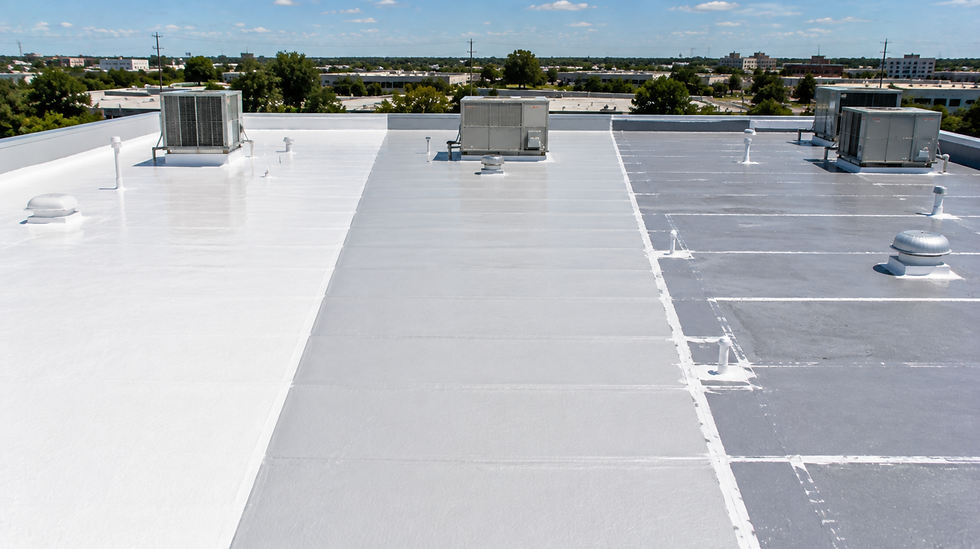
Not every reflective coating suits every building, and the right choice depends on the existing roof, drainage behavior, and how long you plan to hold the property.
Silicone coatings handle ponding water better than most options and hold up well under constant sun, which makes them a frequent choice for flat roofs with slow drainage.
Acrylic coatings offer strong reflectivity at a lower cost and apply easily, though they perform best on roofs that drain reliably.
Elastomeric coatings stretch and recover with the roof as it moves through daily temperature swings, which helps on assemblies prone to seam stress.
Existing roof composition matters too. Modified bitumen, single-ply membranes, metal panels, and built-up roofs each require different preparation and primer selection. An assessment from a consultant who works in coatings specifically is the fastest way to narrow the options.
What a Coating Project Involves
Inspection and moisture survey. The roof is evaluated for saturated insulation, failing seams, drainage problems, and substrate condition.
Repairs. Wet material is removed, penetrations are resealed, and any structural or drainage issues are corrected.
Cleaning. The surface is thoroughly cleaned so the coating bonds properly. Skipping this step causes more coating failures than any other factor.
Priming. Most substrates need a primer suited to the material to ensure adhesion.
Application. The coating is applied at the specified thickness, usually in multiple passes with reinforcement at seams and penetrations.
Documentation. Records of the work protect warranty coverage and give you a baseline for future maintenance.
At RoofHelp! | Coatings, that assessment step is where most projects genuinely start, because a coating recommendation only holds up if the roof underneath is a fit for it. Residential property owners can get an initial estimate through the virtual roof quote tool before scheduling an on-site visit.
Frequently Asked Questions
How long does a reflective roof coating last?
Most properly applied systems perform for ten to twenty years depending on the coating type, thickness, and maintenance. Recoating at the end of that cycle typically costs far less than the original application.
Will a reflective coating make my building colder in winter?
There is a small heating penalty in cooler months, but in South and Central Texas the summer cooling season is long enough that the net effect is clearly positive.
Can a coating be applied over any commercial roof?
Most low-slope systems are candidates, including modified bitumen, single-ply membranes, metal, and built-up roofs. Condition determines suitability more than material type. Widespread saturation or structural damage rules a roof out.
How soon will I see savings on the utility bill?
Cooling reductions appear in the first full summer after application. Comparing bills to the same months in previous years, adjusted for weather, gives the clearest picture.
Does the roof need maintenance after coating?
Yes. Annual inspections, drain clearing, and periodic cleaning preserve both the waterproofing and the reflectance. Neglected coatings lose performance well ahead of schedule.
Conclusion
Reflective roof coatings do reduce cooling costs, and in a climate like San Antonio's the effect is real enough to show up on a utility bill. The buildings that benefit most tend to be single-story, lightly insulated, and covered by an aging low-slope roof that is still structurally sound. For those properties, the combination of lower cooling demand, extended roof life, and avoided replacement cost usually makes a stronger case than the energy savings alone.
The way to know where your building falls is to have the roof evaluated by someone who can measure its condition rather than estimate from the ground. Schedule a roof assessment to find out what your roof is actually costing you and what a coating system would change.


Comments