
What Roof Surface Temperature Has to Do With Your Next Leak


Nobody calls about heat. They call about a stain spreading across a ceiling tile in the conference room. But by the time that stain appears, the roof has been telling a longer story, and most of it has to do with temperature.
Take a surface thermometer up to a dark modified bitumen roof in San Antonio at two in the afternoon in July. You will read 150 to 180 degrees. The membrane climbs to that number by late morning, holds it for hours, then sheds thirty or forty degrees once the sun drops. Around here that cycle repeats roughly two hundred days a year. Everything that eventually goes wrong on that roof traces back to it.
Heat Does Not Stop at the Membrane
Roofing materials shed water well. Stopping heat was never really the assignment. Whatever solar energy the surface does not reflect gets absorbed, and absorbed heat has to go somewhere. Some radiates back to the sky overnight. The rest conducts down through the membrane, the insulation, and the deck, into the space you are paying to cool.
Warehouse owners notice it first because there is less between the deck and the floor. Office tenants notice it as afternoon complaints from the west side of the building. Facility managers see it in run times on the rooftop units and on the summer bill. For four months out of the year the roof behaves like a solar collector, and the HVAC equipment spends that whole stretch fighting it.
Seams and Penetrations Give Out First
Heat damage almost never starts in the open field of a roof. It starts at the details.
Every material up there expands and contracts at its own rate. The membrane moves one amount. The metal flashing moves more, and faster. Wherever two dissimilar materials meet, which is to say at every pipe boot, curb, drain sump, and parapet transition, that difference has to be absorbed by an adhesive or a sealant. Run that cycle a few thousand times and things start to let go. Laps creep open a sixteenth of an inch. Sealant hardens and pulls back from the substrate. Fasteners back out. Nothing dramatic, and nothing you would spot from the parking lot.
UV runs in the background through all of it, breaking down the oils and plasticizers that keep a membrane flexible. Once a membrane stops flexing, movement has nowhere to go but into a crack.
So the water you found last week was not the beginning of the problem. It was the point where the heat finally made an opening big enough. Click here to learn more about why roof coatings stop leaks at the source.
What an Infrared Scan Is Actually Telling You
Thermal imaging shows up on most commercial inspections now, and it helps to know what you are looking at.
Scanned from inside the building, the camera reads the underside of the deck. Uncoated sections come back hot. Sections carrying a reflective system come back cooler, frequently by fifteen or twenty degrees at the deck, same building, same afternoon. That difference is a straight measurement of solar energy the surface turned away before it became a load on your air conditioning.
Scan from the roof after sunset and the camera does something else entirely. Wet insulation holds heat longer than dry insulation, so saturated areas keep glowing after the rest of the roof has given up its warmth. That is how a moisture map gets built without cutting a dozen test squares, and it is how you learn whether a leak stayed put or traveled sideways through the insulation boards.
Do both scans before anyone quotes coating work. Put a reflective system over wet insulation and the water is still in there, now with a lid on it.
What Reflectance Actually Buys You

Two properties drive the whole thing. Solar reflectance is how much sunlight the surface throws back before it turns into heat. Thermal emittance is how readily the surface releases whatever heat it did take on. Both are scored from zero to one, and both numbers determine how cool a roof stays in service.
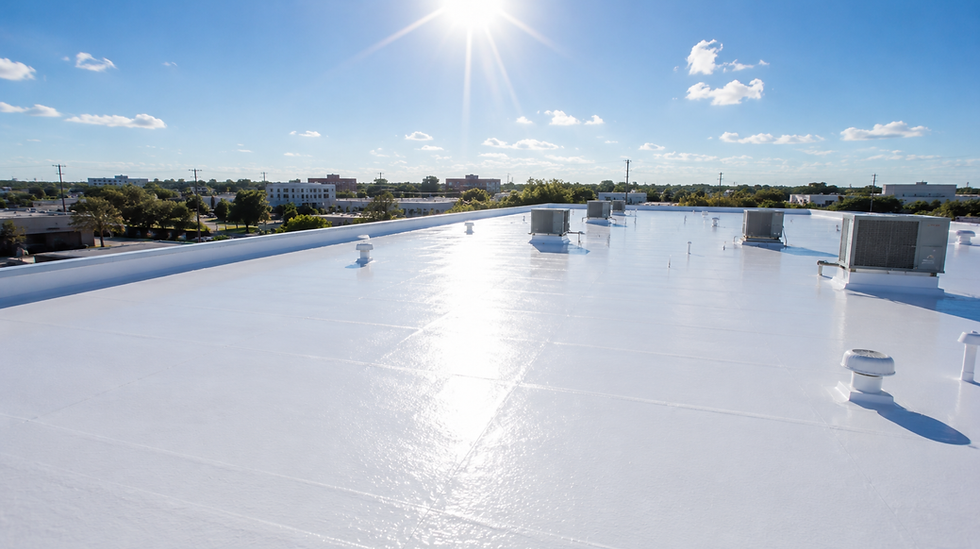
A quality white silicone or acrylic system usually starts around 0.85 reflectance with strong emittance. An aged bitumen surface sits closer to 0.10. On a Texas roof that gap works out to a surface running 50 to 70 degrees cooler at peak, with cooling reductions that generally land somewhere between ten and thirty percent depending on insulation, occupancy, and how the mechanical equipment is configured.
Owners tend to focus on the utility savings, which is fair. The part that matters more over fifteen years is what a cooler membrane stops doing. It expands less, contracts less, and oxidizes slower. Shrink the daily temperature swing and you shrink the fatigue that pulls seams apart. Meanwhile the coating goes over those seams and penetrations during installation, so the leak history and the heat problem get handled in the same mobilization.
Full Roof or Problem Areas Only
Plenty of buildings do not need a complete system this year. When an inspection turns up a roof in reasonable shape with two or three bad zones, treating just those areas is a defensible call. Reinforcing fabric and coating over the failing flashings and laps stops the active leaks, and the crew is off the roof in days instead of weeks. The budget survives and the roof gets breathing room.
The tradeoff is that the rest of the field keeps absorbing heat and aging on its original schedule. If you go this route, plan the rest of it. Treat the problem zones now, coat the full surface within a couple of budget cycles, and write it down somewhere. The buildings that end up needing replacement are usually the ones patched in five unrelated places across ten years with nobody tracking any of it.
Where Coatings Fall Short
A reflective system will not dry out saturated insulation and it will not fix drainage. If water is still standing forty-eight hours after a storm, that gets solved before anything else goes down. Structural deck damage is a different trade entirely.
Reflectance also drops as the surface collects dirt, pollen, and whatever blows off the highway, which is why aged values tell you more than initial values, and why a rinse every year or two is part of owning a reflective roof.
Then there is prep. Pressure washing, repairing failed details, and choosing the right primer for the substrate decide whether the system runs fifteen years or three. Nearly every early coating failure traces back to a shortcut on the surface, not to the product in the bucket.
FAQ
How hot does a commercial roof get in San Antonio?
Dark, uncoated membranes commonly reach 150 to 180 degrees on summer afternoons. A white reflective surface on the same building usually runs in the 90s to low 100s.
Will a reflective coating stop an active leak?
Yes, if the leak is coming from membrane or flashing failure and the insulation underneath is dry. Anything wet has to come out and be replaced first.
Does a reflective roof cost me anything in winter?
Very little here. Central Texas has a long cooling season and a short heating one, so the summer benefit outweighs the winter penalty by a wide margin on low-slope buildings.
Can we stay open during the work?
Yes. Everything happens on the roof surface. No tear-off means no debris, no interior disruption, and no dumpster taking up your parking spaces.
Is my roof too old to coat?
Condition matters more than age. A twenty-year-old roof with dry insulation and repairable details is often a better candidate than a ten-year-old roof that has been leaking into the deck for two seasons.
Conclusion
Roofs rarely fail in an afternoon. They fail across thousands of heating and cooling cycles, at the details where movement concentrates, while the same heat driving that damage runs up what you spend to cool the building. Bringing the surface temperature down deals with both at once.
Before you commit to anything, get the roof looked at properly and insist on a moisture scan. What the insulation is doing will change the recommendation more than anything you can see from the surface. RoofHelp! | Coatings inspects commercial and residential roofs throughout San Antonio, New Braunfels, Boerne, and the surrounding Central Texas area. Schedule a roof evaluation and find out what yours needs before another summer works on it.


Comments