
Flat Roof Waterproofing in Texas: What Actually Keeps Water Out


Flat roofs almost never fail the way people expect them to. There is rarely a single dramatic breach. What happens instead is a slow accumulation of small openings at seams, curbs, and flashings, each one letting in a little water during each storm, until saturated insulation finally pushes moisture through the deck and someone downstairs notices a stained ceiling tile. By then the repair bill has very little to do with the roof surface and quite a lot to do with everything underneath it.
The good news for property managers across San Antonio and the surrounding Hill Country is that most low-slope roofs reach that point long before the structure itself is finished. A roof that is still sound underneath can usually be sealed, protected, and put back into service for another decade or more without touching the deck.
What Waterproofing Actually Means on a Low-Slope Roof
The term "flat roof" is misleading. A properly built low-slope roof is designed with a slight pitch, often around a quarter inch per foot, so water moves toward drains and scuppers rather than sitting still. Waterproofing is not simply a matter of installing something impermeable on top. It is the combination of two things working together: a continuous barrier with no weak points, and a drainage path that clears water quickly.
Break either half and the other one eventually fails too. A perfectly sealed membrane still degrades if water stands on it for days. A well-drained roof still leaks if the flashing at a curb has pulled loose. Any serious waterproofing plan has to address both.
Why Central Texas Is Harder on Flat Roofs Than Most Climates
Roofing systems age faster here than the manufacturer's literature usually suggests, and the reasons are worth understanding before you spend money on a fix.
Daily thermal movement. A dark low-slope roof surface in a San Antonio July can run far hotter than the air temperature, then drop sharply after an evening thunderstorm. The material expands and contracts through that swing every single day. Seams, laps, and fastener heads absorb most of that stress, which is precisely why they tend to open first.
Rain that arrives all at once. Central Texas does not get gentle rain. A single afternoon cell can drop several inches in under an hour, which means drainage capacity matters far more than annual rainfall totals suggest. Water that cannot leave fast enough backs up at low spots and finds any opening available.
Relentless ultraviolet exposure. UV breaks down exposed roofing materials from the surface down. Granules loosen on modified bitumen, single-ply surfaces chalk and stiffen, and older asphalt-based systems lose the flexibility they need to move with the building.
Hail and debris. Spring storms leave bruising, punctures, and displaced surfacing that often go unnoticed until the next heavy rain proves they exist.
Where Flat Roofs Actually Leak
Field leaks in the open middle of a roof are uncommon. In practice, the water almost always comes in at a detail.
Penetrations and equipment curbs. HVAC units, exhaust fans, conduit, and pipe boots create dozens of interruptions in an otherwise continuous surface. Sealant at these points has a much shorter service life than the roof itself.
Seams and laps. Every joint between sheets is a manufactured weak point that thermal cycling works on year after year.
Flashings and edge metal. Terminations at parapet walls, curbs, and roof edges are where movement concentrates.
Drains and scuppers. Clamping rings loosen, strainers disappear, and debris backs water up around the very opening designed to remove it.
Previous patchwork. Layers of mismatched sealant and asphalt patches often trap moisture rather than shed it, and they hide the actual source of the leak.
Any waterproofing approach that ignores these details and simply covers the field of the roof is treating the wrong problem.
How Coating Systems Waterproof an Existing Roof

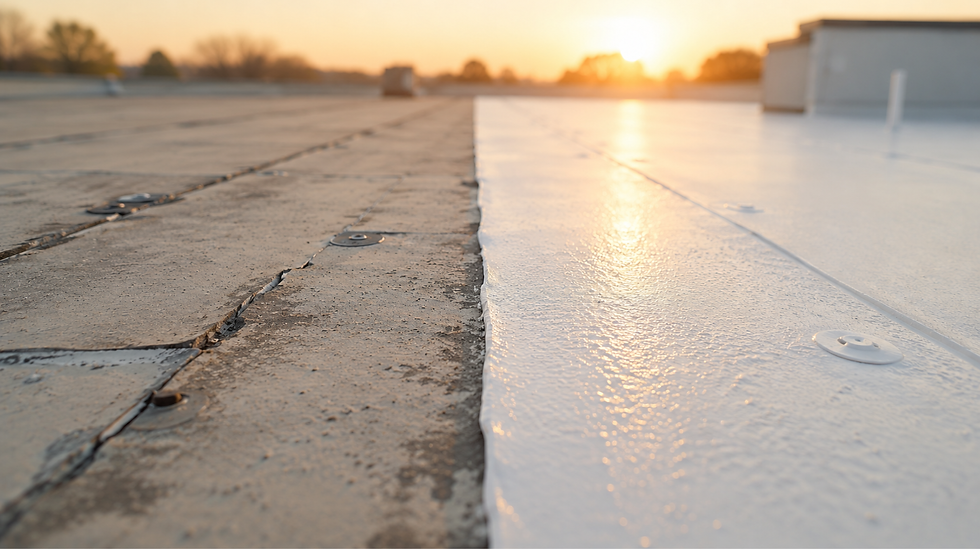
A liquid-applied coating system solves the seam problem by eliminating seams. The material is spread across the entire roof surface and cures into one continuous, flexible skin that flows around penetrations and up onto curbs. There is no lap for water to work through because there is no lap.
These are not paints. Coatings are applied at many times the thickness of ordinary architectural finishes and cure into an elastic film capable of bridging small cracks and moving with the substrate as it expands and contracts. That elasticity is what allows a coating system to survive Texas thermal cycling instead of cracking through it.
Silicone Coatings
Silicone is the default recommendation on roofs where water lingers. It does not soften or break down under standing water, it holds up well against UV, and it stays flexible over time. If the roof has low spots that hold water after a storm and correcting the slope is not practical, silicone is usually the right chemistry.
Acrylic Coatings
Acrylic systems are water-based, highly reflective, and cost-effective across large areas. They perform very well on roofs that drain properly and take the surface temperature down substantially in the process, which reduces both cooling load and the thermal stress that ages the roof. They are less suited to roofs with chronic ponding.
Elastomeric Systems Generally
Elastomeric coatings are chosen for movement tolerance. Combined with reinforcing fabric embedded at seams, curbs, and penetrations, they turn the roof's most vulnerable details into its most heavily protected ones. That detail work is where a good restoration separates itself from a mediocre one, and skipping it is the single most common reason coating projects disappoint. Click here to learn more about how roof coatings stop leaks for good.
Drainage Comes Before Anything Else
Check your roof roughly two days after a heavy rain. Anything still holding water at that point is a low spot, and low spots deserve attention before a single gallon of coating is ordered.
Clear drains and scuppers quarterly at minimum, and again after any storm that brings down leaves or branches. Confirm strainers are in place. Look at the area immediately around each drain for sagging insulation, which is often the first physical evidence of a saturated deck.
What a Proper Assessment Looks Like
Coatings work extremely well on the right roof and poorly on the wrong one. The difference is determined during the evaluation, not during application.
A thorough assessment identifies whether moisture is already trapped in the insulation, whether the existing surface will hold a coating, and whether the substrate has enough life left to justify the investment. Saturated areas have to be opened, dried, and repaired first. Adhesion is verified on the actual roof rather than assumed from the membrane type. Consultants at RoofHelp! | Coatings look at all of this before recommending a system, because a coating applied over wet insulation simply seals the moisture in and guarantees a failure later.
If the evaluation shows widespread saturation or structural deterioration, restoration is not the answer and a straight assessment will say so.
Maintenance That Keeps the System Working
Two scheduled inspections a year, plus a walk after every significant hail or wind event, catches nearly everything before it becomes expensive.
Late winter is the time to prepare for spring storms and clear accumulated debris. Late summer is the time to look for heat-related stress at seams and terminations. After any storm, check for punctures, displaced flashing, and blocked drains. Document what you find with photos and dates, because a roof file that shows condition over time makes every future budget conversation easier.
Signs You Should Not Wait On
Water still standing more than 48 hours after rain
Blisters, bubbles, or soft spots underfoot
Multiple small leaks appearing in different areas
Exposed insulation or visible deck material
Rooftop equipment settling into the roof surface
Interior stains that reappear after previous repairs
Multiple leaks in unrelated locations usually indicate a system nearing the end of its service life rather than a set of isolated failures, and continuing to patch individual spots typically costs more over three years than addressing the roof as a whole.
Frequently Asked Questions
How long does a coating system last on a flat roof?
A properly prepared and correctly specified system generally delivers 10 to 20 years of added service life, and most can be recoated at the end of that period to extend protection again without removing anything.
Can a coating be applied over a roof that already leaks?
Active leaks are repaired first. Coatings seal and protect a sound substrate, so any wet insulation and damaged decking must be addressed during preparation. Applying over trapped moisture causes the system to fail early.
Will a coating handle ponding water?
Silicone systems are formulated for extended water contact and perform well where water lingers. Acrylic systems are better suited to roofs that drain properly. The evaluation determines which chemistry fits your roof.
Does a reflective coating actually lower energy costs?
Yes, particularly on air-conditioned buildings in South and Central Texas. Reflecting solar energy off the surface reduces heat entering the building and eases the load on rooftop HVAC equipment during peak afternoon hours.Yes, particularly on air-conditioned buildings in South and Central Texas. Reflecting solar energy off the surface reduces heat entering the building and eases the load on rooftop HVAC equipment during peak afternoon hours.
How do I know whether my roof qualifies for restoration instead of replacement?
It comes down to the condition of the deck, the amount of trapped moisture, and how well the existing surface will accept a coating. A moisture survey and adhesion testing answer the question with real data rather than a visual guess.
Conclusion
Waterproofing a flat roof in Texas is less about buying the most expensive product and more about understanding where your particular roof is vulnerable and addressing those points before water finds them. Drainage that clears quickly, details that are reinforced rather than merely sealed, an honest assessment of what is happening beneath the surface, and a maintenance schedule you actually follow will protect a building far more reliably than an emergency repair budget ever will.
If your low-slope roof is showing its age, the practical next step is a professional evaluation that tells you what condition the system is truly in and what it will take to keep water out for the next decade. Schedule a roof assessment and find out what your options are.


Comments