
What Causes a Roof Coating to Wash Off, and How to Prevent It


A property manager walks the roof a few days after the crew packs up and finds white streaks running down toward the drains. Gray patches where the finish coat should be. The invoice is already sitting on her desk.
Nothing was wrong with the material. The crew sprayed it on the wrong day.
Wash-off is one of the few coating problems that traces back almost entirely to scheduling, and most building owners have never heard of it until it happens to them. It is worth understanding before you sign a proposal, because the questions that prevent it are easy to ask and take about two minutes.
Wash-Off Is a Curing Problem
Water-based coatings, acrylics especially, cure by giving off water. The material goes on wet, that water evaporates into the air, and the solids left behind knit into a continuous membrane. Until the evaporation finishes, the film is still soluble. Put water back on the surface during that window and the whole thing runs.
You can usually tell what you are looking at. The streaking follows the slope. On metal, it collects in the flat pans between ribs. On a low-slope roof, it pools around drains and low spots. Base coat shows through in patches that have no relationship to foot traffic or wear. The coating never finished what it started.
Dew Ruins More Applications Than Rain Does
Rain is the threat everybody watches. Any crew worth hiring has the radar open. The one that actually causes most winter failures is dew, which shows up overnight on a day the forecast called clear.
Dew forms once a surface cools to the point where the surrounding air can no longer hold its moisture and condensation begins. Metal roofs get there fast. Steel sheds heat quickly after sunset and often drops below the air temperature by mid-evening, so a roof can be genuinely wet hours before sunrise.
The damage compounds. A fresh coating takes on dew overnight. If the next day stays mild and humid, the surface never warms enough to drive that moisture back out, so the film goes into a second night still uncured. Then a third. Crews have watched applications come apart three full days after the last rain fell, on a job where nobody did anything obviously wrong.
Mild temperatures, high humidity, and a clear night are a bad combination, and they do not look like one from the ground.
Central Texas Does Not Have a Simple Coating Season
Summer in San Antonio is straightforward in one respect. Heat drives moisture off fast, and cure times shorten accordingly. The complication is the afternoon storms that build off the Gulf with very little warning.
Late fall and winter are where projects get into trouble. A front moves through, temperatures settle into the seventies, and the roof feels like a pleasant place to work. Gulf moisture comes back in behind the front, humidity climbs, and overnight lows slide into the fifties. Those nights produce heavy dew, and the following afternoon rarely gets warm enough to undo it.
New Braunfels and San Marcos run into the same pattern with the added wrinkle of river-valley fog in the early morning. Boerne and the surrounding Hill Country cool off noticeably faster after sunset than the urban core, which quietly shortens the usable curing window on what looks like the same weather day.
What Careful Crews Do Differently
They read three days of weather, not one. The application day is the least important part. Overnight lows, dew point, and humidity for the following 48 to 72 hours are what decide the outcome.
They stop early. Spraying should end several hours before sunset so the film gets real daylight and warmth to work with. A crew still going at 5:30 on a November afternoon is taking a chance with your roof.
They spray thin and build up. When a system calls for two gallons per hundred square feet, three light passes cure far more reliably than two heavy ones. Thick material holds water in the middle of the film long after the top feels dry.
They check the deck, not just the air. Roof surfaces sit well below air temperature in the early morning. Starting over a substrate that is still damp from overnight condensation compromises adhesion before curing gets going.
They think about color. A darker base coat absorbs more heat and dries faster than white. On a borderline day that difference decides whether the work holds.
When a Moisture-Cure System Makes More Sense
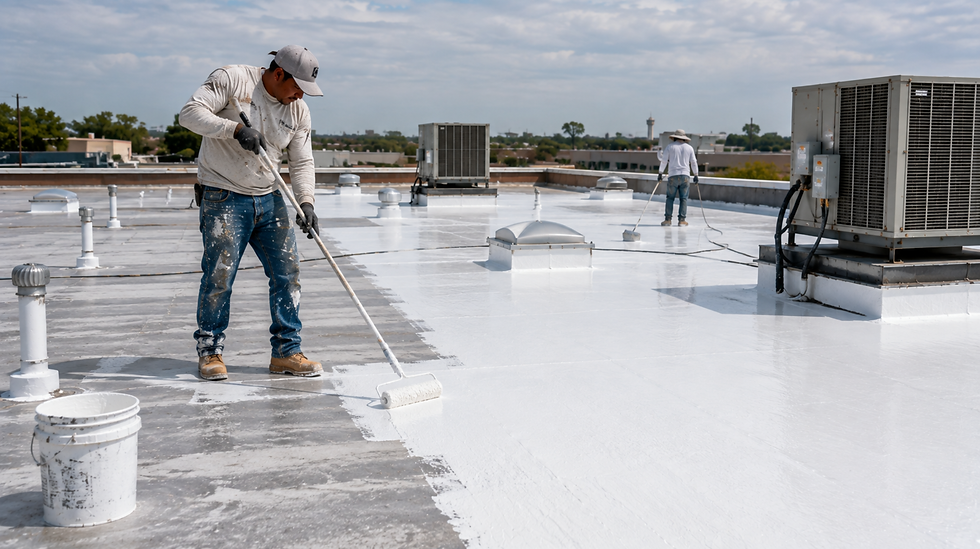
Acrylics are good products. They reflect well, they cost less per square foot than most alternatives, and they have decades of field history on flat and metal roofs. Their weakness is entirely in the installation window.
Silicone works the other direction. It uses ambient moisture to trigger the cure instead of releasing water, so humidity helps rather than hurts. Applied over a clean, dry surface, a silicone system has no wash-off exposure at all. When a project runs into a humid stretch in December, or the building cannot afford to have its roof out of service twice, that is often the deciding factor.
Substrate condition, ponding, reflectivity goals, and the calendar all feed into the specification. A roof that ponds after every rain points one direction. A metal building with sound panels and a tight budget points another. Click here to learn more about how roof coating systems build long-term durability.
Five Questions Before the Sprayers Come Out
You do not need to learn coatings chemistry. You just need to hear whether the contractor is thinking past tomorrow.
What are the overnight lows and dew points for the two nights after application?
What time does the crew stop spraying each day?
How many passes is the system going on in?
What happens to the schedule if humidity climbs mid-week?
Would a moisture-cure product be safer this time of year?
Anyone who has run coating crews through a Texas winter can answer these without hesitating.
If It Already Happened
Wash-off is recoverable. Affected areas get cleaned, the remaining film gets checked for adhesion, and the failed sections go back on under better conditions. What you cannot do is let it ride through a season, because exposed base coat and bare substrate offer no real protection and the roof underneath resumes aging immediately. Take dated photos before anyone touches anything. That documentation matters if the conversation turns to warranty coverage.
Frequently Asked Questions
How long does an acrylic coating need before rain is safe?
There is no fixed number. Cure time shifts with temperature, humidity, film thickness, and wind. On a hot, dry August afternoon a coating can be rain-resistant within a few hours. On a mild, humid January day it can take well past 24 hours. Plan around a clear multi-day window rather than a stopwatch.
Can a coating wash off if it never rained?
Yes. Heavy dew alone will do it, and that accounts for a large share of cold-weather failures.
Is silicone always the better choice in a humid climate?
No. Silicone eliminates wash-off risk during installation, but acrylics deliver strong reflectivity at a lower cost and hold up well when applied under the right conditions. The call should come out of a roof assessment.
Does a wash-off void the warranty?
That depends on the terms and the cause. Applying outside manufacturer-specified conditions usually gets treated as workmanship rather than product defect, which is another argument for hiring crews who log weather conditions during the job.
How do I tell a wash-off from normal weathering?
Timing and pattern. Wash-off appears within days of application, with directional streaking and visible base coat. Weathering takes years and shows up as even chalking across the whole surface.
Conclusion
A coating is only as good as the conditions it cured in. No product on the pallet can make up for a crew that started too late in the afternoon or ignored the dew point for the two nights that followed. Most failures of this kind come down to a schedule built around crew availability instead of weather.
Before you commit to a coating project, ask how the timing was chosen and why that particular system fits the season you are actually in. The answers tell you a lot.
If your roof is due for restoration, or you are looking at a coating that did not hold, the team at RoofHelp! | Coatings can assess the condition, recommend a system that suits both the building and the current weather pattern, and give you a realistic timeline. Schedule a roof assessment and find out where your roof actually stands.


Comments